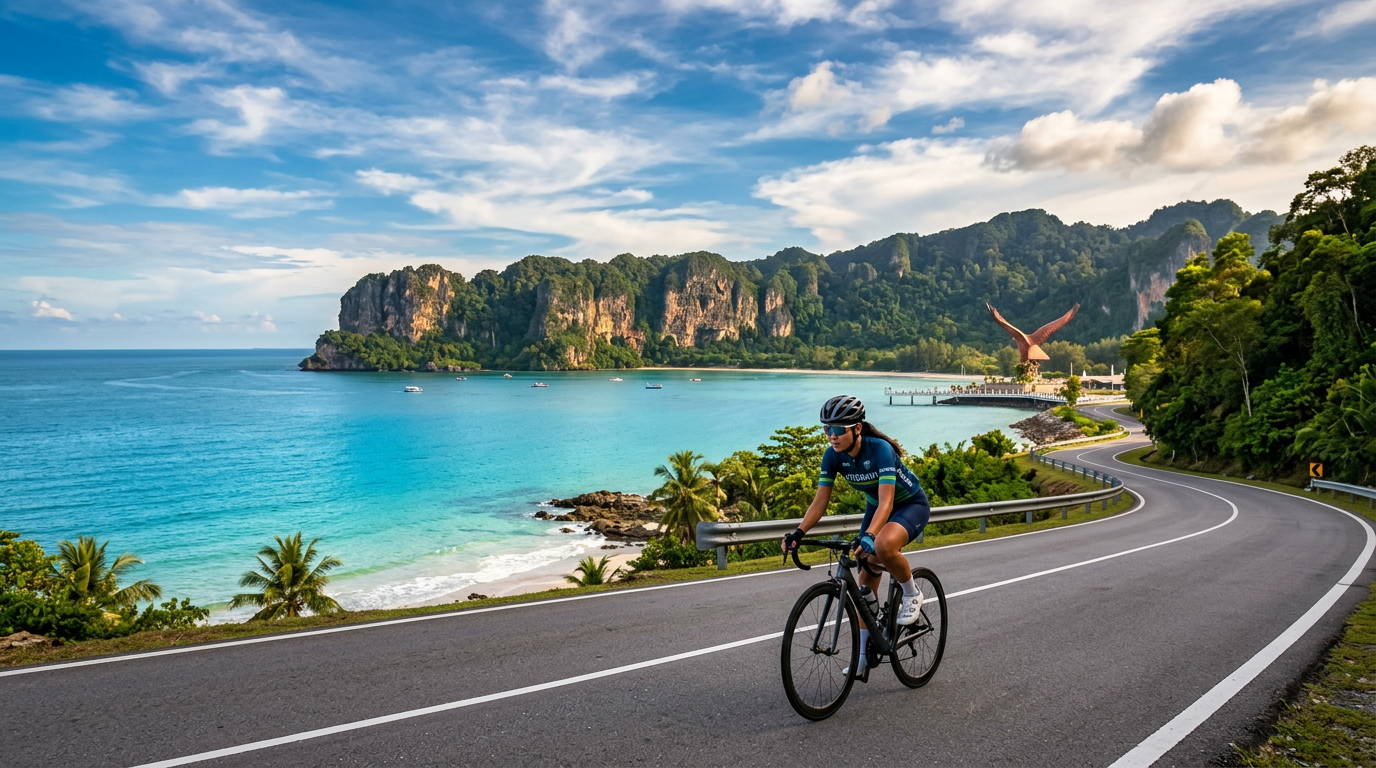
Cycling in Langkawi
Mostly flat coastal roads with a few steep climbs in the island's mountainous interior
December to April (dry season), mornings year-round
Le Tour de Langkawi legacy — ride the same roads as the pros, Langkawi Island loop — 60 km of quiet coastal roads, UNESCO Global Geopark scenery with ancient limestone formations
Overview
Langkawi holds a special place in Malaysian cycling history as the spiritual home of Le Tour de Langkawi (LTDL), the premier professional stage race in Southeast Asia. The island has hosted stages of the race since its inaugural edition in 1996, and the legacy is visible everywhere — from road surfaces improved for racing to the cycling culture that permeates the island.
Beyond its racing heritage, Langkawi is simply a stunning place to ride. The island is part of a UNESCO Global Geopark, with 550-million-year-old geological formations, ancient rainforest, pristine beaches, and dramatic limestone cliffs providing a constantly changing backdrop. The roads are quiet by Malaysian standards, the air is cleaner, and the island’s compact size means you can explore thoroughly even on shorter rides.
The duty-free status of the island is a bonus — post-ride drinks and supplies are notably cheaper than on the mainland.
Popular Routes
Langkawi Island Loop (60 km, Easy to Moderate)
The full circumnavigation of the island follows the main coastal road and is the quintessential Langkawi ride. Starting from Kuah town, head clockwise along Jalan Pantai Cenang, past the airport, through Padang Matsirat, along the northern coast through Tanjung Rhu, and back down the eastern side to Kuah.
The route is predominantly flat with a few rolling sections, particularly on the northern and eastern coasts. Road surfaces are generally excellent, having been maintained for LTDL stages. Traffic is light outside of Pantai Cenang and Kuah. The scenery shifts from beach resorts to mangrove forests, rice paddies, fishing villages, and dramatic rocky headlands. Allow 3-4 hours at a comfortable pace, with stops.
Gunung Mat Cincang Climb (8 km, Hard)
The climb towards the top of Langkawi’s second-highest peak starts near the Oriental Village at the base of the cable car station. The road ascends steeply through rainforest, with gradients reaching 12-15% in places. The paved road extends about 8 km before becoming a trail. This climb has featured in LTDL stages and is a genuine test. The elevation gain is approximately 500 metres, and the views from the upper sections towards the Andaman Sea are spectacular.
Padang Matsirat to Tanjung Rhu (25 km one way, Easy)
A flat to gently rolling route through Langkawi’s quieter northern interior. Starting from the Padang Matsirat area, ride north through rice paddies and small kampungs to the stunning Tanjung Rhu beach. The road passes through some of the most authentic parts of the island, far from the tourist strip. Tanjung Rhu itself is one of Malaysia’s most beautiful beaches, with views of limestone karsts rising from the sea.
Pantai Cenang to Pantai Kok (15 km, Easy)
A short, flat ride along the western coast connecting two of Langkawi’s main beach areas. The route follows Jalan Pantai Cenang and Jalan Teluk Baru, passing through the tourist heart of the island. Great for a sunset ride or as a warm-up. Multiple restaurants and cafes line the route for stops.
Gunung Raya Climb (12 km, Very Hard)
The beast of Langkawi. Gunung Raya is the island’s highest peak at 881 metres, and the road to the summit is fully paved. Starting from near Padang Matsirat, the climb averages around 7% over 12 km but includes several brutal ramps exceeding 15%. This has been a decisive stage finish in LTDL history, breaking riders on its relentless gradients. The road is narrow with some surface deterioration in the upper sections. At the summit, the views encompass the entire archipelago. Bring warm clothing for the descent — temperatures drop significantly.
Key Climbs
Gunung Raya and Mat Cincang are the two major ascents. For a shorter challenge, the road climbing inland from Ayer Hangat towards the centre of the island offers a moderate climb with less traffic. Keen climbers sometimes combine Gunung Raya and the island loop for a punishing long day of 100+ km with over 1,500 metres of elevation gain.
Road Conditions and Safety
Langkawi’s main roads are in excellent condition, largely thanks to LTDL infrastructure investment. Secondary roads are patchier, with occasional loose gravel and potholes. The island loop road is well-surfaced throughout.
Traffic is generally light, but be cautious around Pantai Cenang and Kuah where tourist rental cars (often driven by visitors unfamiliar with the roads) are common. Scooters rented by tourists are another hazard — ride defensively. The mountainous roads to Gunung Raya and Mat Cincang are narrow with limited visibility on bends, so descend with caution.
Weather and Best Times to Ride
Langkawi’s dry season runs from December to April, which is the ideal riding window. During this period, expect hot and sunny conditions with temperatures of 30-34 degrees Celsius at sea level. From May to November, the island receives more rain, with September and October being the wettest months.
Start rides early, ideally before 7 AM. The island’s relatively small size means you can complete most routes before the midday heat. For the major climbs, early starts are essential — both for cooler temperatures and clearer skies at altitude.
Where to Eat and Refuel
- Kuah town hawker stalls — Affordable local food near the ferry terminal, ideal for pre-ride or post-ride meals. Try the nasi campur and mee goreng
- Tomato Nasi Kandar (Padang Matsirat) — Popular with locals, generous portions of rice with various curries
- Pantai Cenang restaurants — The main tourist strip has everything from Malay to Western food, though prices are higher
- Tanjung Rhu Beach cafes — Simple refreshments at the beach, perfect after the northern ride
- Warung Nasi Ayam Kampung (near the airport) — Excellent kampung-style chicken rice, a favourite among local cyclists
- Kok Payung restaurant (Kuah) — Known for fresh seafood at reasonable prices
Local Bike Shops
- Langkawi Cycling (Kuah) — The island’s main bike shop, offering rentals, servicing, and guided ride packages
- Dev’s Adventure Tours — Offers cycling tour packages and can arrange bike hire for independent riders
- Pantai Cenang sports shops — A couple of general sports shops stock basic cycling supplies (tubes, pumps, tools)
Bike shop options are more limited than on the mainland, so bring essential spares if you are riding seriously. Carry a spare tube, mini pump, and basic multi-tool.
Getting There and Logistics
Langkawi International Airport (LGK) has direct flights from KL (1 hour), Penang (30 minutes), and Singapore. Alternatively, take a ferry from Kuala Perlis or Kuala Kedah on the mainland (1-1.5 hours). Ferries can accommodate bikes, though you may need to negotiate space.
Most accommodation on the island is in the Pantai Cenang or Kuah areas, both good bases for cycling. Several resorts and guesthouses will store bikes securely. Given the island’s compact size, you can ride to any starting point from either base within 30 minutes.
Car rental is cheap on Langkawi (as low as RM 50/day), useful for transporting bikes to climb starting points or exploring more remote parts of the island.
Upcoming Events in Langkawi
Langkawi MTB Jamboree 2026
Langkawi, Kedah
30km (Day 1 - XC) · 25km (Day 2 - Trail)
Gunung Jerai Hill Climb Challenge 2026
Gurun, Kedah
13km
FeaturedLangkawi Gran Fondo 2026
Langkawi, Kedah
60km · 110km · 160km
FeaturedIRONMAN Malaysia Langkawi 2026
Langkawi, Kedah
180km (bike leg) · 90km (70.3 bike leg)
Cycling in Langkawi?
Get personalised recommendations for routes, events, and services in this region.
Chat on WhatsApp